
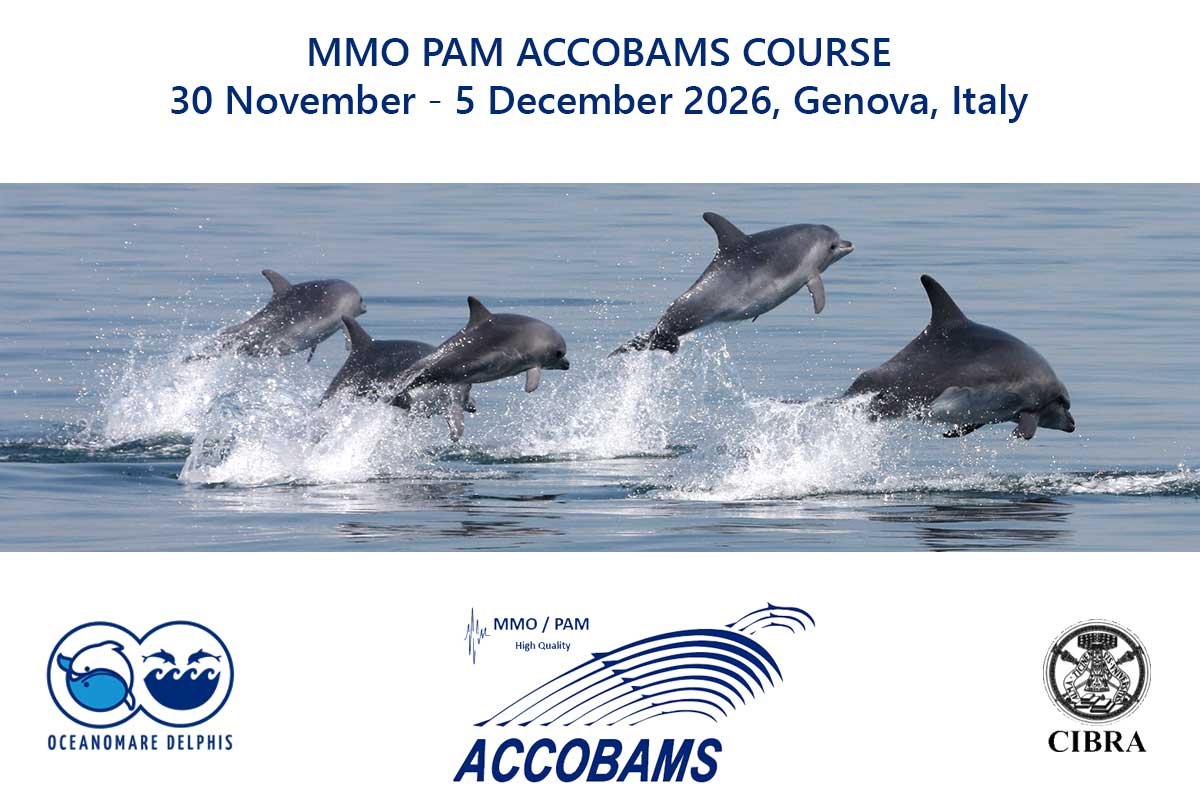

30 November – 5 December 2026 Genoa
Oceanomare Delphis Onlus and CIBRA (Interdisciplinary Center for Bioacoustics and Environmental Research), under the agreement signed with ACCOBAMS (Agreement on the Conservation of Cetaceans in the Black Sea, the Mediterranean Sea and contiguous Atlantic area), are organizing a brand new training course to qualify individuals as Marine Mammal Observers and operators of Passive Acoustic Monitoring systems.
When: from November 30 to December 5, 2026
Where: Blue Ship, Genoa Aquarium, Genoa (Italy)
Participation Fee: 800 euro
The qualification: The ACCOBAMS qualification qualifies people to work as MMOs/PAM operators throughout the Mediterranean and the Black Sea in 24 countries, where it is the agreed course requirement for such work. After the course, the ACCOBAMS highly qualified MMO/PAM operators will be able to minimize the impact of noise on cetaceans by applying the knowledge, expertise, and skills acquired during the training course and using the standard procedures, forms, and manuals, in accordance with the ACCOBAMS principles.
Speakers: Giovanni Caltavuturo, Claudio Fossati, Guido Gnone, Michele Manghi, Barbara Mussi.
Requirements: Graduated/current biology or ecology student or have experience demonstrating a commitment to the environment and its conservation
Minimum 30 days at sea as a marine observer (with references/records)
Ability to recognize the different species and understand the behavior of animals at sea.
Ability to communicate in English.
Have a theoretical understanding of acoustic issues.
Ability to recognize the different vocalizations of marine mammals.
Topics Covered in the Training Course:
Introduction to marine mammals and acoustics
Human activities generating underwater noise and impacts on marine mammals
Existing regulations, mitigation procedures, and ACCOBAMS Guidelines
The role of MMO/PAM and the lifestyle onboard during operations.
Introduction to Geographic Information Systems (GIS) to map acoustic and visual sightings.
Using PAM for survey and research.
Introduction to the hardware used for PAM.
Hands-on training with PAMGUARD-Tips and troubleshooting.
Autonomous acoustic bottom recorders.
The InterCet platform
Practical Sessions (hydrophones: types, use and installation, soundcards and software)
The price includes training, certificate, lunches, and coffee breaks (accommodation is not included).
To apply, please fill out the online form